
A former industrial area is being transformed into a green residential area by the water
Hardinxveld-Giessendam Ironworks
The Hardinxveld-Giessendam Ironworks (De IJzergieterij) is being transformed from a former industrial production site into an open, green residential area alongside the River Merwede. Where heavy and polluting work took place for over a century, a green yet urban residential area is now emerging, reconnecting the village with the river. De Zwarte Hond’s plan and design draw on the rugged scale and appearance of the industrial heritage, translating it into a contemporary living environment with a wide variety of housing types. There are 83 apartments, 51 family homes and 16 compact starter homes are carefully positioned within a landscape of varying elevations. This creates surprising sightlines and an intimate neighbourhood structure. The gatehouse marks the entrance from the village, while the waterfront apartments create a new silhouette along the river. The architecture reinterprets the industrial character into a contemporary residential setting. Bricks with rich, natural colour nuances form the foundation of the neighbourhood and ensure cohesion. Greenery and water form the backbone of the plan. Nature-inclusive design, the preservation of existing trees, and a network of interconnected gardens, squares, and green streets connect the dike, the neighbourhood and the landscape. The low-traffic public space is designed as a shared area, offering places to meet and relax. The streets extend to a public riverside platform where living, recreation and the landscape converge. This creates a pleasant residential neighbourhood behind the dike where the industrial past, the landscape and daily life are interwoven once again.
data
- Location
- Hardinxveld-Giessendam, NL
- Size
- 40.000 m²
- Client
- Gebroeders Blokland
- Discipline
- Architecture
- Program
- Housing
- Period
- 2016-2026
- Status
- Completed
- Photography
- Scagliola Brakkee
- Partners
- Jecon, Megaduct, Mobius
- themes


The context: an industrial waterway
The Ironworks has a long industrial history. Operational from 1897 to 1986, the complex was part of a network of Dutch ironworks that played a pivotal role in the economic development of villages and cities located along waterways. As with many sites along Dutch rivers, it eventually fell out of use, remaining as a forgotten area between the village and the river. However, it is precisely this location that constitutes the area’s core quality. The Ironworks connects Hardinxveld-Giessendam with its industrial past as well as with the River Merwede. The redevelopment represents a re-evaluation of the area and a new relationship with the river.


A layered residential landscape
The layout of the residential area is based on experience, differences in elevation and sightlines. A gateway building marks the entrance to the neighbourhood from the dike. Streets run perpendicular to the dike and gradually descend to the lower ground level, creating a varied yet cohesive streetscape.
Along the dike are three striking apartment buildings that reference the scale and volume of the former industrial buildings and the nearby dry docks. Family homes form the heart of the neighbourhood, situated one level lower and embedded in a green residential environment. The public space is designed as a shared space, where cars, cyclists and pedestrians coexist. The streets have no traditional pavements or cycle paths, instead being paved with cobblestones to reinforce the area’s historic character. To maintain the green and peaceful character of the streetscape, parking has largely been concealed from view. A parking garage is located beneath the apartments on the dike, and additional parking spaces have been incorporated into green ‘boxes’ and along the streets. This ensures the neighbourhood remains car-friendly without cars dominating the streetscape.
The streets lead to a public riverside platform. This square is an important meeting place, offering views of the River Merwede and the Biesbosch National Park. The platform is inviting for residents and visitors thanks to its wide seating elements and large planters.
A public function space, such as a hospitality area or sports facilities, has been reserved in the plinth of the central apartment building. This will help ensure that the riverside becomes a lively part of the neighbourhood, used every day.


Contemporary robust brick homes
A social and diverse lifestyle
The Ironworks offers a variety of housing types, including 83 compact apartments, 51 spacious family homes (including semi-detached and detached houses), and 16 compact starter homes. This range of housing types contributes to a mixed and lively neighbourhood.
Particular attention has been paid to the transition between private and public spaces. Front gardens have a semi-open character, featuring hedges, verandas and pergolas, which encourage social interaction. The homes are oriented so that the front and back gardens are well used. Kitchens and dining rooms face the street side, while the living rooms open onto the garden. In this way, the architecture supports everyday life and informal contact between residents.
A new place to live on the Merwede, offering space, tranquillity and character.


Architecture, materials and landscape
The architecture translates the industrial character into a contemporary residential environment. A nuanced brick with rich, natural colour variations forms the basis of the neighbourhood and ensures cohesion. Variation is created through the craftsmanship of the masonry, with alternating stretcher and header bonds that reference industrial building traditions.
The slim, slender window frames surrounding the large glass surfaces reinforce the buildings’ robust aesthetic. They are made from contemporary, well-insulated materials. Greenery provides a complementary contrast to the architecture. The neighbourhood has been designed according to nature-inclusive building principles, with existing trees preserved and varied planting featured to promote biodiversity and climate adaptation. Rainwater is collected locally and released slowly to create a sustainable living environment in which nature, water and housing are in balance.


1. West block, 2. Semi-detached house, 3. Gatehouse block

1. West block, third floor

1. West block, fifth floor
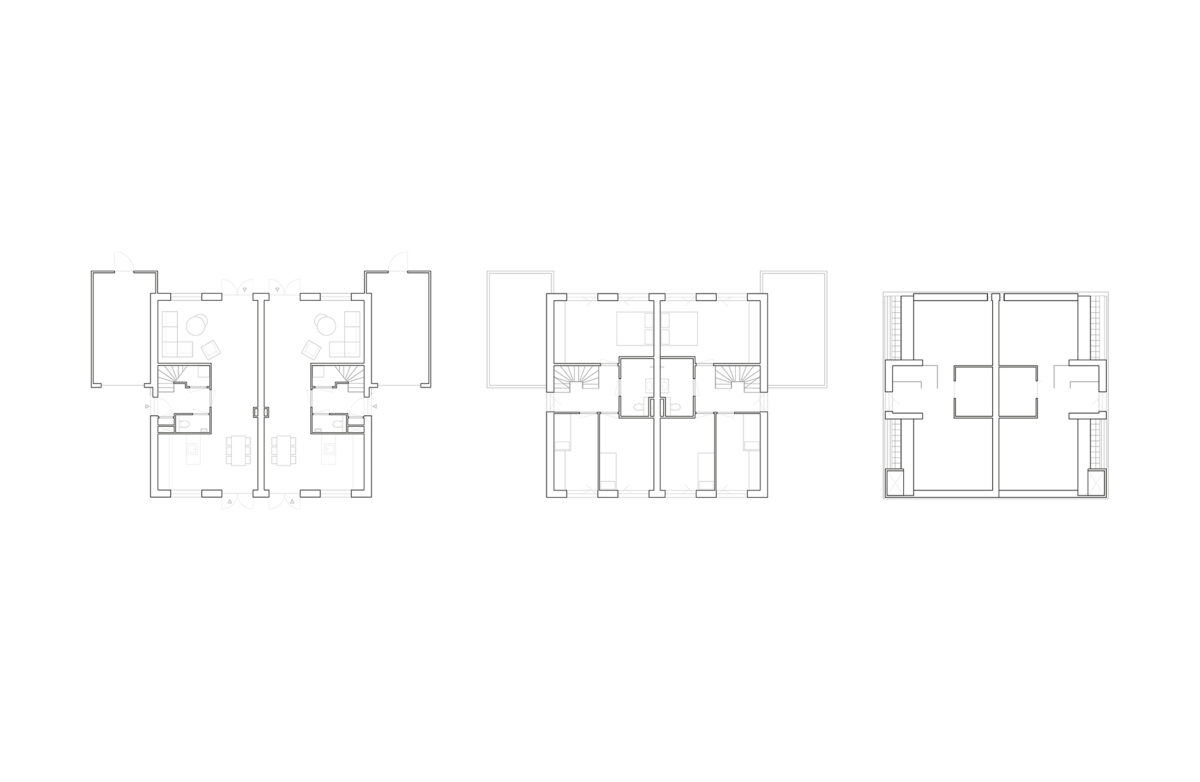
Semi-detached house: ground floor, first and second floors

Gatehouse second floor


